


A lockout station is only as effective as the accessories stocked within it. Having the right devices on hand, organised and immediately accessible, is the difference between a compliant safety program and a gap that could cost a worker their life. This guide covers the most important accessories to consider when building or upgrading your lockout tagout station.
Why the Right Accessories Make All the Difference
A lockout station serves as the central hub for your facility’s energy isolation program. Its primary role is to ensure that every worker performing maintenance or servicing on plant and equipment can access the correct devices immediately, without delay or improvisation. When the wrong accessories are present, or when critical items are missing, workers may be tempted to proceed without proper isolation, which creates exactly the kind of hazardous situation that lockout tagout procedures are designed to prevent.
Under Australian Work Health and Safety legislation and standards including AS 4836, employers have a clear duty to provide the means for safe isolation of plant and equipment. A well-stocked lockout station is one of the most practical and visible expressions of that duty. It signals to every worker on site that energy isolation is taken seriously, that the right tools are always available, and that there is no acceptable shortcut.
The accessories covered in this guide represent the core items that should be present in any serious lockout tagout program, regardless of industry or facility size.
| KEY POINT | A lockout station that is missing even one critical accessory type can force workers to improvise during isolation procedures. Improvised lockout is one of the leading contributors to serious injuries and fatalities during maintenance activities across Australian workplaces. |
Safety Padlocks
Safety padlocks are the foundation of any lockout tagout program. They are the physical mechanism that prevents an isolation point from being re-energised while a worker is still carrying out maintenance. Every lockout station should carry an adequate supply of padlocks to cover the number of workers who may be performing isolation tasks simultaneously.
There are two main keying configurations to be aware of. Keyed-different padlocks ensure that each lock can only be opened by the individual worker who holds its unique key, which is the standard requirement for personal lockout procedures. Keyed-alike padlocks allow the same key to open multiple locks and are useful in specific operational contexts where supervisors need the ability to manage a set of locks uniformly, although they require careful management to avoid compromising individual accountability.
Padlock colour coding is widely used on Australian industrial sites to differentiate between departments, trades, or worker categories. Assigning specific colours to specific teams makes it immediately obvious who has locked out a piece of equipment and which trades are still working, which is particularly valuable during complex multi-trade shutdowns.
Locksafe supplies Masterlock 410 and Lockwood 312 padlocks for personnel use, available in keyed alike or keyed differently configurations. Both models are available in a range of colours and can be custom engraved to suit your site’s identification requirements. Padlocks with stainless steel shackles and non-conductive nylon bodies are a popular choice for general industrial use across Australian manufacturing, utilities, and food production environments.
| BEST PRACTICE | Every worker who performs isolation procedures should be issued their own personal padlock that is not shared with any other person. The key remains on the worker’s person for the duration of the task. Only that individual should remove the lock once the work is complete and the area is confirmed safe. |
Lockout Hasps
Lockout hasps allow multiple workers to simultaneously apply their own padlock to a single isolation point. This is essential in any situation where more than one person is working on the same piece of plant or equipment, as it ensures that the isolation cannot be released until every worker has removed their individual lock upon completing their portion of the task.
Locksafe manufactures an extensive range of scissor and tamper-proof hasps to suit different isolation device configurations and working environments. Scissor-style hasps use a pivot-action design that accommodates multiple padlocks, while tamper-proof models feature reinforced construction to resist unauthorised interference. Most hasps accommodate between four and six padlocks, which is sufficient for most group maintenance tasks. Locksafe can also customise any hasp to meet specific site requirements.
It is important to keep enough hasps on the station to cover any situation where group lockout is required. A hasp that is missing from the station at the start of a job will either delay the task while a replacement is sourced or, in a worst-case scenario, lead a worker to proceed without adequate isolation.
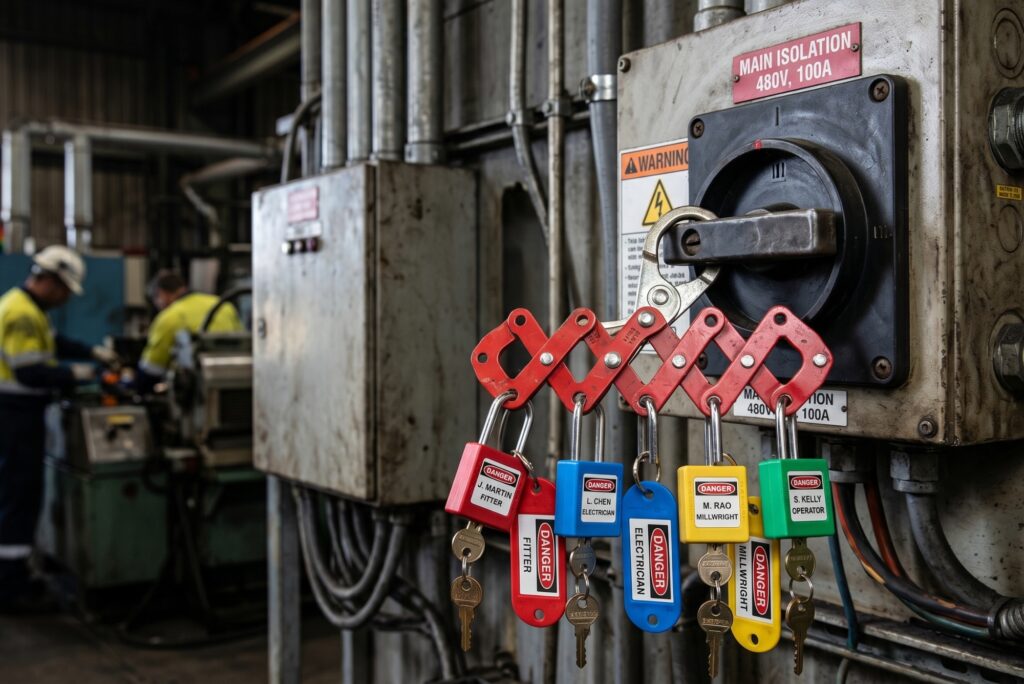
| IMPORTANT | A hasp must never be used as a substitute for a padlock on a single-worker lockout. Its purpose is specifically to enable multiple locks to be applied to one point. Using only a hasp without any padlock provides no security at all and does not constitute a valid lockout. |
Danger Tags and Identification Tags
Tags are a mandatory companion to padlocks in any compliant lockout program. They serve as a visible communication tool that identifies who has applied a lock, why the equipment has been isolated, and what work is being carried out. Without a tag, other workers on site have no way of knowing the reason for the lockout, which can create confusion and unsafe behaviour.
Danger tags indicate that equipment must not be operated under any circumstances and that a worker’s safety depends on the lock remaining in place. Identification tags communicate supplementary information about the isolation, including the worker’s name, the date and time, and a brief description of the work being performed. Both types should be made from durable materials that resist tearing, moisture, UV exposure, and the chemical environments common in industrial workplaces.
Locksafe stocks LS18006 ID Tags suitable for Australian industrial environments. You can browse the full range on the specialty products page to find options suited to your site conditions and compliance requirements.
Lockout Bags
Lockout bags are used to store and transport the full set of personal lockout devices a worker needs during a maintenance task. They keep padlocks, hasps, tags, and other devices organised and immediately accessible, reducing the risk of a worker beginning an isolation procedure without the correct equipment.
Locksafe supplies lockout bags in four sizes: small, medium, large, and extra-large, each available in red or yellow for easy colour coding by department or trade. Colour-coded bags complement colour-coded padlocks, giving a clear visual system for identifying which worker or team owns a particular set of devices.
For facilities where workers move between different areas of a site or work across multiple locations, lockout bags are particularly valuable. They ensure that each worker carries their own complete isolation kit at all times, rather than relying on a fixed station that may not be accessible from every maintenance point.
| DID YOU KNOW? | Locksafe lockout bags are available from small through to extra-large, with both red and yellow colour options in each size. Matching your bag colour to your padlock colour makes it immediately clear which worker’s isolation kit is in use at any point. |
Valve Lockout Devices
Valve lockout devices are designed to secure valves in the closed or open position to prevent the release of stored energy from water, steam, gas, compressed air, hydraulic, or chemical systems. They are an essential accessory for any facility that operates process pipework, and they must be correctly matched to the valve type and size to function as intended.
Locksafe stocks a range of valve lockout devices through the specialty products range, including options for different valve configurations commonly found in Australian industrial and commercial settings. The LSMA485 Rotating Gate Valve Lockout is a heavy-duty option built for larger rotating gate valves in mining and heavy processing environments. Standard valve lockout models (LS16001 through LS16005) cover the most common configurations across water, gas, pneumatic, and hydraulic systems.
Stocking a range of valve lockout sizes is important because facilities rarely use only one valve type or size. A lockout station that only carries one valve lockout configuration will be inadequate the first time a worker encounters a different valve during a maintenance task.
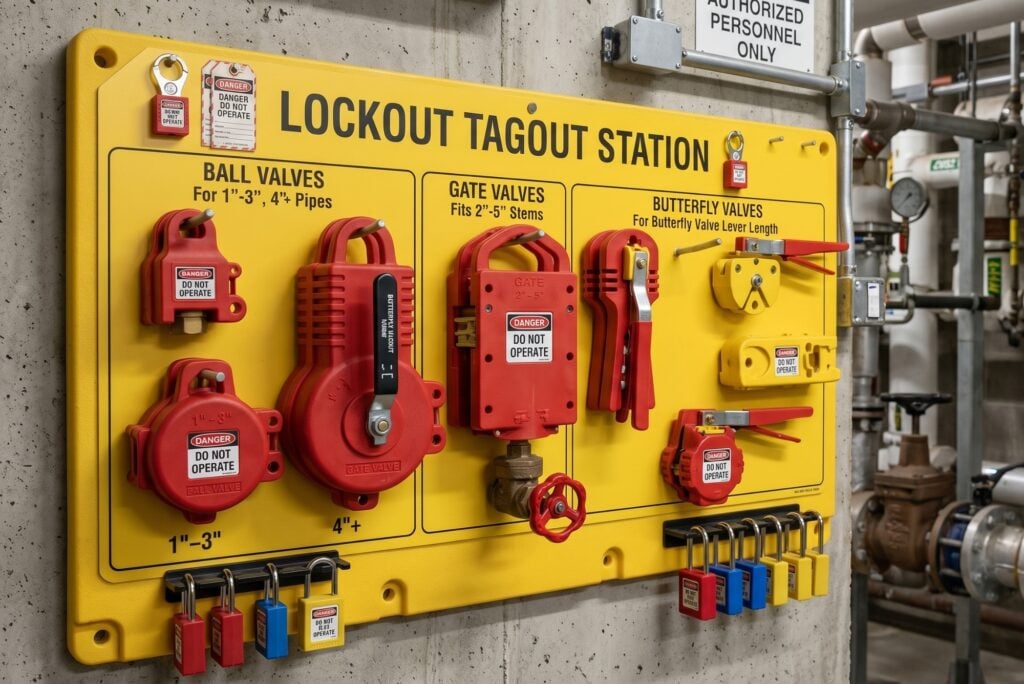
Ball valve lockouts
Ball valve lockouts encircle the valve body and prevent the lever handle from being rotated. They are designed for quarter-turn valves and are available in sizes that accommodate the most common pipe and valve configurations found in Australian industrial and commercial settings.
Gate valve lockouts
Gate valve lockouts are designed for multi-turn handwheel valves and work by preventing the wheel from being rotated. They are commonly used in water treatment, chemical processing, and heavy manufacturing environments where gate valves are the primary flow control mechanism.
Butterfly valve lockouts
Butterfly valve lockouts are clamshell-style devices that surround the valve actuator disc and prevent it from being repositioned. They are particularly common in food and beverage production, water utilities, and HVAC systems where butterfly valves are widely used for their efficiency and low maintenance requirements.
Electrical Plug Lockouts and Lockout Plates
Not every isolation point has a dedicated lockout device port, and not every piece of equipment connects to a fixed circuit. Electrical plug lockouts and lockout plates address two of the most common scenarios where a standard padlock alone is not sufficient.
Electrical plug lockouts fit over the plug of portable equipment once it has been disconnected from its power source, preventing the plug from being re-inserted. Locksafe supplies two models: the LSMA487 and the LSMA488, in different sizes to suit the range of plug configurations used on Australian industrial sites. They are particularly useful for portable tools, trailing leads, and equipment that is regularly moved between work areas.
Lockout plates (LS11033 and LS11033L) are flat devices that cover switches, push buttons, and panel openings, preventing them from being operated once the lockout plate is secured with a padlock. They are a straightforward and low-cost solution for equipment where the isolation point is a push-button or recessed switch that cannot be locked directly.
| COMPLIANCE NOTE | Under AS 3000 and WHS regulations, all switches and controls that serve equipment subject to isolation procedures must be capable of being locked in the off position. If any controls in your facility cannot accept a lockout device, this represents a compliance gap that should be addressed promptly. |
Group Lockout Boxes
A group lockout box is used in complex maintenance scenarios where a job requires multiple isolation points across different energy sources and involves several workers or contractors. Rather than each worker applying their padlock to every individual isolation point, all isolation devices are first applied, and their keys are then placed inside the group lockout box, which is closed and each worker applies their personal padlock to the box.
The equipment cannot be re-energised until all isolation keys are retrieved from the box, which can only happen once every single worker has removed their lock. This approach streamlines group lockout procedures considerably and provides a clear visual record of how many workers are still active on the job at any given time.
Locksafe supplies the LSGLB01 Group Lock Box, available in standard and red versions, at a straightforward price point that makes it accessible for facilities of any size. Group lockout boxes are particularly valuable in shutdown maintenance, turnaround operations, and any scenario where multiple trades are working simultaneously on interconnected systems.
For guidance on selecting the right group lockout box size and configuration for your site, visit our padlocks and storage range where our team has curated options suited to Australian workplaces of all sizes.
| BEST PRACTICE | When using a group lockout box, a responsible person such as a supervisor or permit issuer should apply their own lock as the final step before work commences. This ensures that even if all individual workers have completed their tasks and removed their locks, the box cannot be opened until the supervisor confirms that the area is safe and the work is complete. |
Padlock Boards, Racks, and Storage
A well-organised lockout station goes beyond simply having the right devices. It also needs to store them in a way that makes their presence or absence immediately visible to any worker approaching the station. Padlock boards and racks serve this purpose, providing a designated place for every device and making it obvious at a glance when something is missing.
Locksafe offers a range of padlock storage solutions including the LSPADRK Padlock Rack, the LSPB-L Large Padlock Board, and customisable padlock isolation boards that can be configured to suit your site’s specific device inventory. Fixed padlock boxes (LSFPB20 and LSFPB26) provide secure wall-mounted storage, while the LSPPB29 Portable Lockout Station is a compact mobile option for sites where workers need to bring isolation equipment to the job rather than access a fixed station.
A consistent approach to device storage reduces the risk of devices being misplaced, borrowed for non-lockout purposes, or simply left at an isolation point without being logged. It is a simple discipline that significantly improves the reliability of your overall lockout tagout program.
Quick Reference: Key Lockout Station Accessories
The following table summarises the primary accessories covered in this guide along with their purpose and the applications where they are commonly most required.
| Accessory | Primary Purpose | Best Suited For |
|---|---|---|
| Safety padlocks | Physically secure isolation points during maintenance | All individual and group lockout procedures |
| Lockout hasps | Allow multiple workers to apply their own padlock to a single point | Group maintenance tasks with two or more workers |
| Danger and ID tags | Communicate isolation status and prevent accidental re-energisation | All lockout procedures as a mandatory companion to padlocks |
| Lockout bags | Store and transport personal isolation devices between work areas | Mobile workers and sites with multiple maintenance locations |
| Valve lockout devices | Secure ball, gate, and butterfly valves in the off position | Water, steam, gas, pneumatic, and hydraulic systems |
| Electrical plug lockouts | Cover and secure plugs once disconnected from power | Portable equipment, trailing leads, and moveable machinery |
| Lockout plates | Cover switches and push buttons that cannot be locked directly | Panel controls, recessed switches, and push-button isolators |
| Group lockout boxes | Hold keys to multiple isolation points in one secured location | Complex shutdowns with many isolation points and workers |
| Padlock boards and racks | Organise and visually account for all devices on the station | High-traffic stations in manufacturing, mining, and utilities |
Building a Station That Grows with Your Safety Program
A lockout station that is stocked thoughtfully and maintained consistently is one of the clearest indicators of a safety culture that takes energy isolation seriously. The accessories described in this guide form the foundation, but the right configuration for your station will ultimately depend on the specific plant and equipment on your site, the number of workers who perform isolation tasks, and the nature of the energy sources involved.
Reviewing your station’s contents regularly, replacing worn or damaged devices promptly, and ensuring that workers know how to use each accessory correctly are all ongoing responsibilities that sit alongside the initial setup. A station that was well-equipped at commissioning can become inadequate over time as plant and equipment changes, staffing levels shift, or regulatory requirements evolve.
Investing in the right accessories from the outset, and committing to regular review, is far less costly than the alternative. A single serious injury arising from an inadequate lockout procedure carries consequences that extend well beyond any regulatory penalty and can affect a workplace for years.
Not Sure Which Accessories Your Station Needs?
A lockout station is not a set-and-forget piece of safety infrastructure. The most effective programs treat it as a living system, regularly audited, replenished, and updated to reflect the current hazards and procedural requirements on site. The accessories you invest in today are the protection your workers rely on tomorrow.
Our team can help you build a station setup that is fully stocked, compliant, and suited to your site’s specific energy sources and maintenance requirements. Get in touch at locksafe.com.au/contact.


