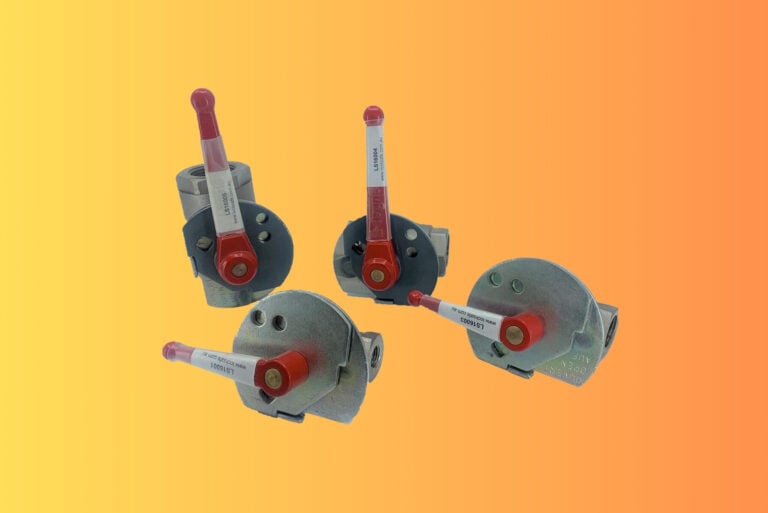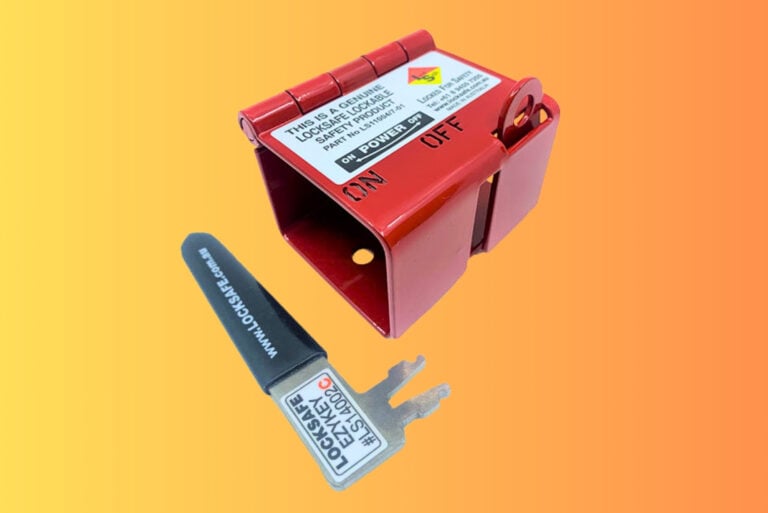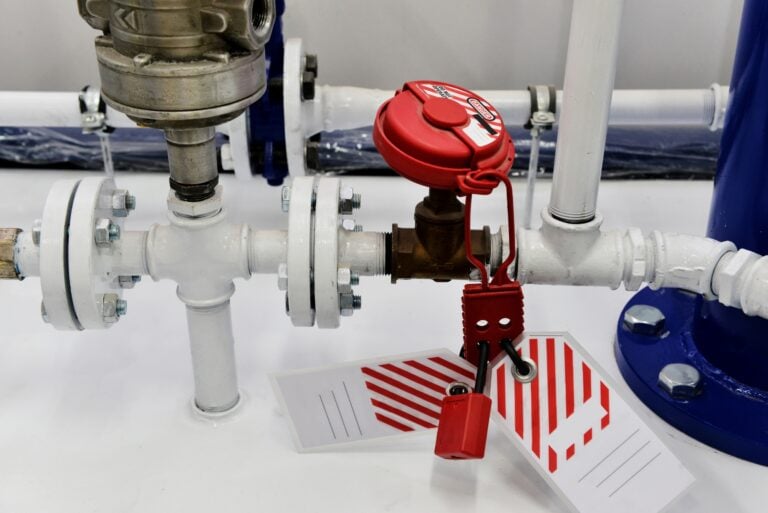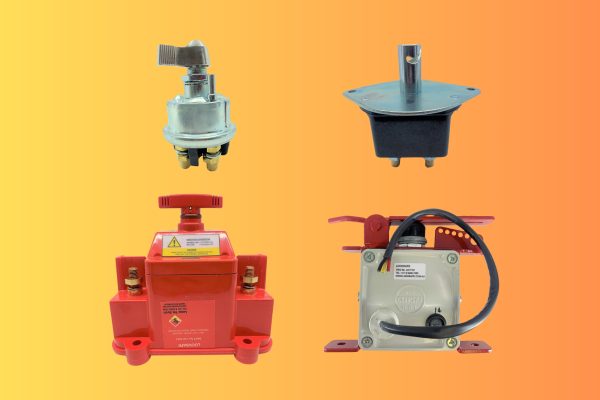
Three numbers decide which battery isolation switch fits a machine: continuous amperage, intermittent amperage and the mounting hole diameter. The continuous rating has to carry the running load, the intermittent rating has to survive the starter surge, and the mounting diameter has to match the locking bracket you isolate with. Brand, terminal count and remote shut off follow from there. The Locksafe isolation switch range runs from 125 A continuous to 500 A, on 19 mm, 22 mm and 24 mm mounts.
What does a battery isolation switch do?
A battery isolation switch is a manual switch that breaks the main cable between the battery and everything downstream of it. Turning it off kills power to the starter, the electrical accessories and any parasitic draw. On heavy plant equipment it also gives maintenance crews a single point to isolate and lock before work starts.
That second job is where the choice gets technical. A switch that only has to disconnect a parked truck is a different specification to one that sits on an isolation point a fitter locks off every shift.
Continuous or intermittent: which amperage rating matters?
Both, for different reasons. The continuous rating is the current the switch carries all day without overheating. The intermittent rating is a short burst, measured in seconds, that covers the starter motor drawing hard on a cold morning. Size the continuous rating to the machine’s running load and the intermittent rating to the cranking current.
The gap between the two is wide. Hella publishes its heavy duty master switch at 2,500 A for 10 seconds, 600 A for 2 minutes and 250 A continuous at 60°C ambient, and that is the switch Locksafe lists as the LS14017. A 2,500 A figure on a product page is not current; the switch will hold for a minute, let alone a shift.
The short ratings across the Locksafe range sit between 750 A and 3,500 A. The continuous ratings sit between 125 A and 500 A, and the continuous figure is the one that decides whether a switch runs hot in service.
Do you need a 12V or a 24V switch?
Most heavy duty isolation switches carry a single rating that covers both systems. Hella rates the 6EK 008 458-011 at 12/24V on the one part number, and the Bosch and Cole Hersee switches Locksafe stocks work the same way. The exception is the Big Red range, which comes as a separate 12V model and 24V model.
So the voltage question matters at two points. It matters when you order a Big Red, because the LS14010 is the 24V unit and the LS14010S is the 12V unit. It matters again on any switch with a solenoid or a signal circuit in it, because that circuit is voltage specific even when the main contacts are not.
Manual, remote or solenoid operated?
A manual switch is turned by hand at the switch. A remote or solenoid operated switch can be shut down from somewhere else, usually a cab button or an emergency stop, which matters when the switch itself sits in a battery box a fitter cannot reach in a hurry.
The Big Red units include an emergency remote controlled shut off solenoid, which is most of the reason they cost what they cost. The LS17151 trigger switch is the other half of that picture: a 40 A push button in an enclosure with a signal LED, used to activate the park brake solenoid during running checks, with a hole for a padlock.
For most trucks and light plant, a manual switch on a locking bracket does the job. Specify remote shut off when the machine is large enough that reaching the battery box takes real time, or when an operator needs to kill power from the cab.
The Locksafe isolation switch range compared
Every switch Locksafe stocks, with the two amperage figures and the mounting diameter that decides bracket fit. Specs are from the current product pages, and manufacturer data for the Cole Hersee master switches sits on Cole Hersee’s own site.
| Model | Amperage, intermittent / continuous | Mount diameter | Suited to |
| LS14015 Cole Hersee | 750 A / 125 A | 19 mm | Switching positive and negative together, or two separate circuits |
| LS14003 | 1,000 A / 125 A | 19 mm | Light and medium plant, two stud terminals |
| LS14006 Cole Hersee 75910BX | 1,000 A / 125 A | 19 mm | Light and medium plant, main and field studs |
| LS14024 | 1,000 A / 125 A | 19 mm | Alternative to the LS14006, suits LS11004 and LS11004/7 brackets |
| LS14008 Cole Hersee | 2,000 A / 300 A | 19 mm | Higher running loads on a 19 mm mount |
| LS14005 Bosch | 2,500 A / 250 A | 24 mm | Four terminal installs, battery to starter |
| LS14016 Bosch | 2,500 A / 250 A | 24 mm | Same rating as the LS14005, two terminals, suits LS11003 brackets |
| LS14017 Hella | 2,500 A / 250 A | 22 mm | Trucks, buses and earthmoving, suits LS11040 brackets |
| LS14025 Bosch double pole | 3,500 A / 500 A | Suits LS11003-01, 02 and 03 | The highest continuous rating in the range |
| LS14010 Big Red 24V | 2,500 A / 150 A | Enclosure, 188 x 135 x 174 mm | Heavy machinery and marine, remote shut off solenoid |
| LS14010S Big Red 12V | 2,500 A / 150 A | Enclosure, 188 x 135 x 174 mm | As above, 12V systems |
| LS17151 Trigger switch | 40 A | Enclosure, 160 x 110 x 65 mm | Park brake solenoid during running checks, padlockable |
Two things stand out when the range is laid out like this. The LS14024 carries the same specification as the LS14006 at a lower price, and it is the obvious substitute when a fleet is already set up for LS11004 brackets. The LS14025 is the only switch in the range above 300 A continuous, so a machine with a heavy running load has one answer, not several.
Why the mounting diameter decides the rest
The mounting hole sets which locking bracket fits, and the bracket is what turns a switch into a lockable isolation point. A 19 mm switch takes a different bracket to a 22 mm Hella or a 24 mm Bosch, so changing switch brand mid-fleet usually means changing brackets too.
That is the part people get wrong. A switch on its own is not an isolation point. Isolation needs the switch, a locking bracket that holds it in the off position, and a hasp and padlock on the bracket. Order the three together or the machine is back the next week for the bracket. Our LS14008 installation guide walks through a single fit end to end.
Switch, assembly or cabinet?
Locksafe supplies the same switches three ways. The bare switch suits a fleet that already has brackets and mounting plates. An isolator assembly pairs the switch with its bracket and plate, in a battery version and a starter version, which is the usual choice for a new fit. An enclosed assembly or an isolation cabinet adds a housing, which is what mine sites and anything exposed to dust and washdown tend to specify.
One decision sits behind that choice. Work out how many isolation points the machine has before you order. A machine with a battery isolation point and a separate starter isolation point needs two switches and two brackets, and that is why the assemblies are listed in battery and starter variants rather than as one part.
Frequently asked questions
Can a battery isolation switch be locked in the off position?
Not on its own. The switch needs a locking bracket sized to its mounting diameter, and the bracket takes a hasp and a padlock. Locksafe lists brackets by switch model, so the LS11003 suits the Bosch switches and the LS11040 suits the Hella.
What size hole do I need to mount one?
19 mm for the Cole Hersee switches and the LS14003, 22 mm for the Hella LS14017, and 24 mm for the Bosch LS14005 and LS14016. The Big Red units and the LS17151 come in their own enclosures and mount differently again.
Does a battery isolation switch replace lockout tagout?
No. The switch gives you a point to isolate at. The site procedure decides what gets isolated, who locks it, how many locks go on and how zero energy is proven. Treat the switch as hardware that makes the procedure possible.
What happens if the continuous rating is too low?
The switch runs hot in normal service, which shortens contact life and can show up as voltage drop before it shows up as a failure. Match the continuous rating to the machine’s running load rather than to the large number on the box.
Can one switch isolate both the battery and the starter?
The LS14015 can switch positive and negative at the same time, or handle two separate currents. Beyond that, most machines use a battery isolator and a starter isolator as two separate points, which is why the assemblies are sold in those two versions.