The first thing to sort out is that valves and switches need different devices, and only one of them is a bracket.
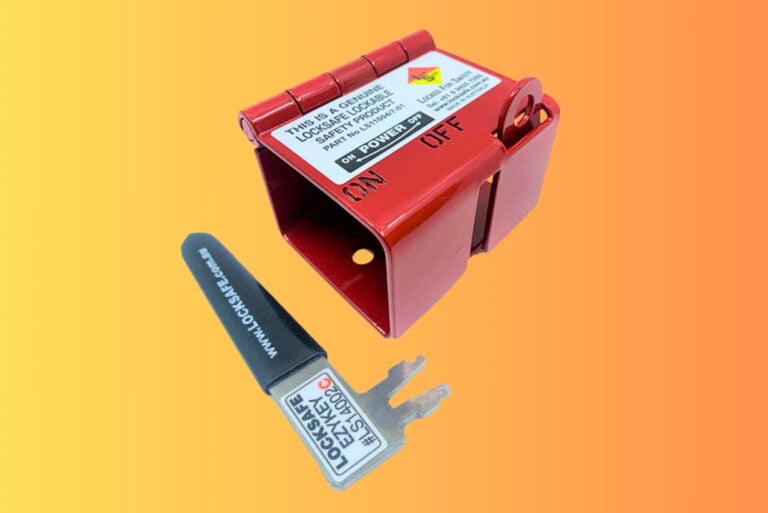
A locking bracket for valves usually isn’t a bracket at all. On compressed air lines you replace the valve with a lockable vented one. On a gate valve you clamp a lockout over the handwheel. Switches are where true brackets come in: a stainless housing that fits over the isolator and gives you a padlock tab.
Buying the wrong category is the expensive mistake, because you don’t find out until the fitter is standing at the point. This guide covers what to check before you order, how the valve and switch options differ, and the questions worth asking the supplier first.
Start With the Isolation Point, Not the Bracket
Most bad purchases start with someone browsing a catalogue. The order that works is the reverse: walk the point first, then find the device.
For each point you need to know four things. What energy source is it isolating, air, hydraulic, electrical or mechanical. What does the operator physically touch, a lever, a handwheel, a rotary switch, a T-handle. What’s the make and model number stamped on it. And how much clearance is there around it once a padlock is hanging off.
That last one gets skipped constantly. A device can be perfectly matched on paper and still be unusable because a cable tray sits 40mm from the handle.
If the point is on mobile plant, also note whether the machine gets pressure washed. Water ingress into an isolator is a slow failure that ends with the switch seizing, and it changes which option you should buy.
Key Measurements to Check Before You Buy
Take these to site with you. It’s a five-minute job per point and it’s the difference between ordering once and ordering twice.
- Model or part number off the switch or valve body itself. Not the machine spec sheet, which is usually out of date after any retrofit.
- Thread size and type for valves. Locksafe’s vented ball valves are BSP, and BSP and NPT are not interchangeable no matter how close they look.
- Handle or shaft dimensions where a clamp or bracket has to close around something.
- Clearance around the point, measured with the padlock in place, not without it.
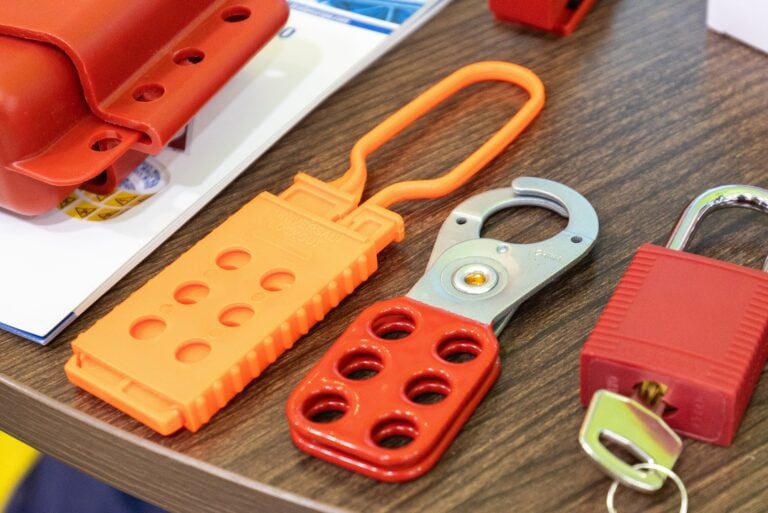
- Number of people who will lock on. This drives whether you need a hasp on top of the device, and how much space that hasp needs.
Photograph every point while you’re there. Locksafe will identify a switch from a photo and tell you which bracket suits it, which is faster and more reliable than working off part numbers you’ve transcribed by hand.
Choosing a Locking Bracket for Valves
Valve isolation splits into two approaches. Pressurised air lines need one, manual valve handles need the other.
Vented ball valves for compressed air
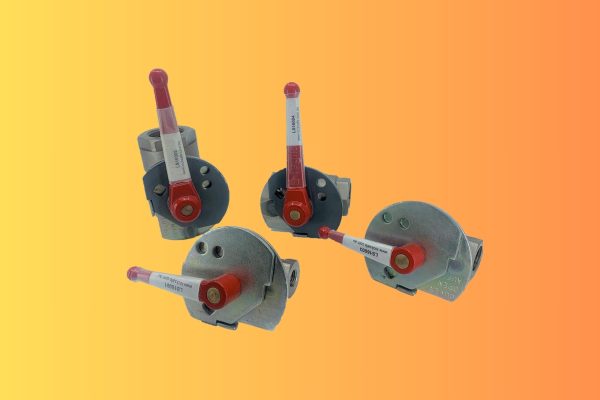
For air lines, the answer is usually to replace the valve rather than clamp something onto it. Locksafe’s LS16001 to LS16005 range is a set of BSP vented ball valves from 1/4 inch through to 1 inch. They fit permanently, lock only in the OFF position, and vent the air trapped between the valve and the equipment to atmosphere.
That venting detail matters more than it sounds. Isolating an airline without venting leaves stored energy sitting downstream, which can drive an actuator on the first crack of a fitting. A lockable vented valve removes that in one step instead of two.
Sizes run 1/4 inch (LS16001), 3/8 inch (LS16002), 1/2 inch (LS16003), 3/4 inch (LS16004) and 1 inch (LS16005). These are priced on application rather than listed, so you’ll need to call with your sizes and quantities.
Clamp style lockouts for valve handles
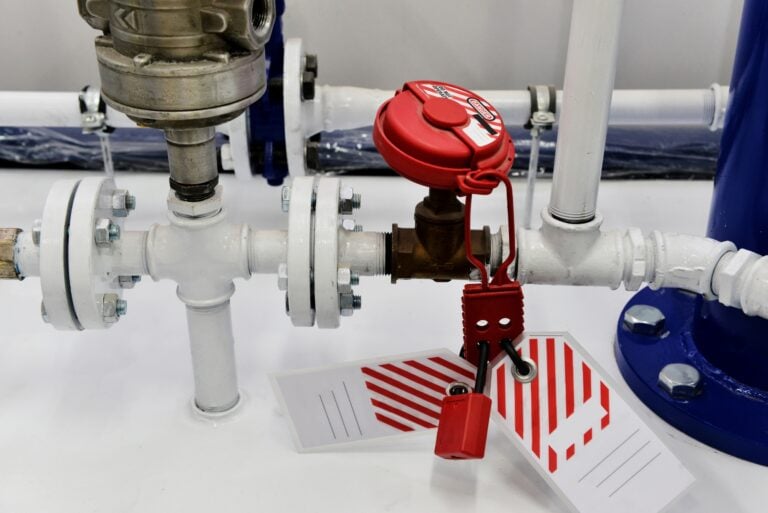
Where the valve stays as it is and you need to secure the handle, the LSMA485 rotating gate valve lockout is the option. It’s a Master Lock unit with a dielectric Zenex body that rotates in and out for storage, and it surrounds the handwheel or handle so it can’t be turned. It ships as a combo pack of five at $445 plus GST.
The dielectric body is worth noting if you’re working anywhere near live electrical equipment or corrosive process fluids, where a steel clamp is the wrong tool.
One honest caveat: there’s no dedicated butterfly valve device in the range. If that’s what you’re isolating, send a photo and ask, because the answer is usually a custom part rather than something off the shelf.
Switch, Breaker and Handle Considerations
This is where actual brackets live, and the range splits by what you’re locking.
Battery isolation switches on mobile plant take the LS11001 to LS11040 series. These are matched to specific switch families, Cole Hersee, Bosch, Hella, Big Red and keyed isolators, and run $117 to $237 plus GST. There’s no universal option, which is why the model number matters so much. Every model in the locking brackets range lists its switch compatibility and dimensions on the product page.
Cabinet and panel handles are a separate range. The LS11058 bolt head lockout and LS11062 T-bolt panel lockout are $35.50 plus GST, the LS11060 T-handle and LS11063 L-handle lockouts are $62, and the LS11062-PC covers push button circuit breakers at $40.50. If your isolation point is a switchboard door rather than a switch, these are what you want.
Emergency stops take the LSESLO at $48 plus GST, which fits over the button so it can’t be reset. Worth knowing about because e-stops get missed on isolation registers regularly. An e-stop is not an isolation device on its own, but locking one out stops someone resetting it mid-job.
Under the Safe Work Australia Code of Practice for managing the risks of plant, plant has to be secured against accidental re-energising before work starts. Every point in your isolation procedure needs a device that actually fits it, or the procedure has a hole in it.
Bracket, Assembly or Custom
Three ways to buy, and the cheapest line item isn’t always the cheapest outcome.
Bracket only makes sense when the existing switch or valve is in good condition and you know the model. $117 to $237 for switch brackets, $35.50 to $62 for cabinet lockouts.
Assembly pairs a new switch with the matching bracket, $314 to $359 plus GST. Buy this when the switch is old, corroded or intermittent. Fitting a bracket to a switch that’s about to fail means doing the job twice.
Custom is worth asking about more often than people do. Locksafe manufactures in house at Canning Vale in Perth and will modify any product in the catalogue, different hole patterns, materials or colours. Prototypes typically land within a week. If you’ve got twenty identical awkward points across a fleet, a custom part usually beats twenty workarounds.
Questions to Ask Before Ordering
Five worth asking every time.
Will this fit my exact model, and can I send a photo to confirm? Photo identification is offered and it removes most of the risk.
Does it install without removing the switch and cables? Most Locksafe brackets do, which turns a two hour job into ten minutes across a fleet.
What’s the padlock hole size? If your site standard lock has a 9mm shackle, an 8mm hole is useless.
Is it rated for the environment? Powder coated stainless handles washdown and dust. A dielectric body is the call near live electrical.
What’s the lead time on quantity? Standard stock is one thing; forty units of a custom part is another.
Where to Start
Do a walk of your isolation register with a camera and callipers before you order anything. Group the points by device type, and you’ll usually find three or four categories covering the lot rather than a dozen one-offs.
For switches and mobile plant, start with the bracket range linked above. For air line and valve isolation, the vented ball valves and gate valve lockouts sit under specialty products. And if the switch is past its best, compare against the isolator assemblies before buying a bracket on its own.