Electrical isolation is the part everyone plans for. The energy that injures people during maintenance is often the air still in the line, the oil holding a ram up, the spring under tension or the machine someone plugs back in. Isolating those takes different hardware: vented ball valves, valve covers, plug enclosures, handle and e-stop lockouts. This guide covers what each one does and where it belongs.
What counts as hazardous energy on a machine?
Hazardous energy is any stored or supplied energy that can move a machine part or release something harmful. The usual list runs to six: electrical, mechanical, hydraulic, pneumatic, thermal and chemical. Gravity makes a seventh on anything that can fall. A machine can hold several at once, and each one needs its own isolation point.
The model code of practice on managing risks of plant in the workplace devotes a section to isolation of energy sources for this reason. Isolating the switchboard does nothing about the accumulator. Our guide to isolation devices and hazard control covers how those points fit into a procedure.
How do you isolate air and hydraulic lines?
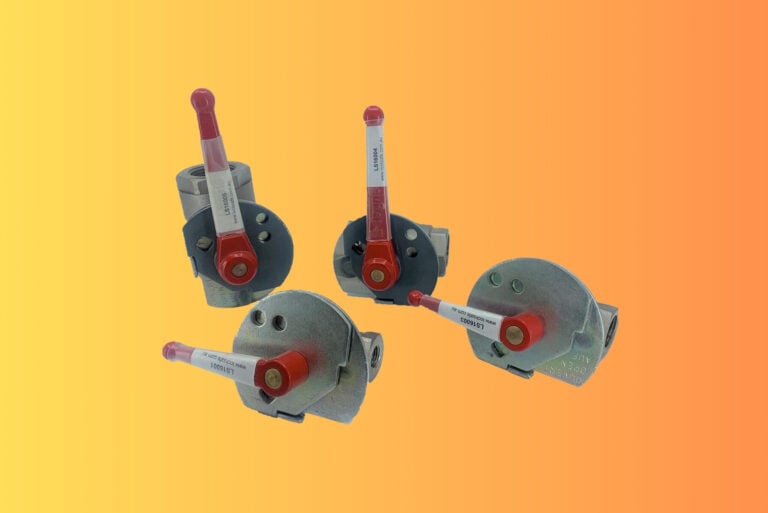
With a valve that locks in the off position and vents what is left downstream. A vented ball valve closes the supply and releases only the air trapped between the valve and the machine, so the rest of the system keeps its pressure. Locksafe supplies them in five BSP sizes, from 1/4 inch to 1 inch.
Two details matter when you specify them. They are fitted permanently, so the valve becomes part of the machine rather than a device someone fetches from a board. And they can only be locked in the off position, which removes the argument about whether the valve was really closed.
Size them to the line, not to the machine. The 1/4 inch and 3/8 inch units weigh 0.5 kg, the 3/4 inch 0.85 kg and the 1 inch 1.2 kg, and the mounting has to carry that on whatever the line is attached to.
The non-electrical lockout range compared
Every device Locksafe stocks for energy that is not a battery or a switchboard. The valve and plug devices sit under specialty products, the handle and bolt head covers under cabinet lockouts.
| Device | What it isolates | Key spec | Where it suits |
| LS16001 to LS16005 vented ball valves | Pneumatic supply plus trapped air | BSP in 1/4, 3/8, 1/2, 3/4 and 1 inch | Permanent isolation points on air lines |
| LSMA485 rotating gate valve lockout | Gate and ball valve handles | Set of five, dielectric Zenex body | Valves you cannot replace, chemical or extreme conditions |
| LSMA487 plug lockout | Plug-in power | Cords to 19 mm, plugs to 57 mm diameter x 82 mm | Smaller leads and portable equipment |
| LSMA488 plug lockout | Plug-in power | Cords to 19 mm, plugs to 76 mm diameter x 152 mm | Larger industrial plugs |
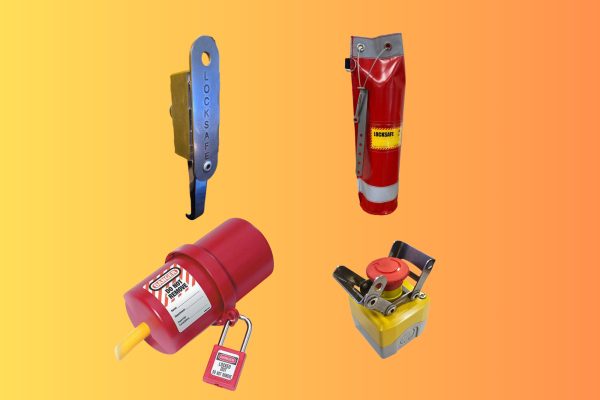
| LSESLO e-stop lockout | Emergency stop button | 1.6 mm stainless, 45 x 45 x 40 mm, 22 mm hole | Schneider 40 mm mushroom head e-stops |
| LS11060 handle lockout, T-handle | Valve and cabinet handles | 65 x 32 x 50 mm, 8 mm hole | T-handle isolators and enclosures |
| LS11063 handle lockout, L-handle | Valve and cabinet handles | 100 x 32 x 28 mm, 8 mm hole | L-handle isolators and enclosures |
| LS10056 conveyor latch lock | Conveyor guard latches | 2.5 mm stainless, 105 x 40 mm, 28 mm jaw | Guard latches on conveyors |
| LS10018 plug and house control lockout | Overhead crane controllers | Red PVC bag, 130 mm diameter x 470 mm | Pendant controls, suits 110 mm PVC tube |
| LS11058 cabinet lockout | Mounting bolt heads | 50 x 49 x 43 mm, 12 x 24 mm slot | Covers a bolt head so it cannot be removed |
What about a valve you cannot replace?
Cover the handle instead. The LSMA485 is a Master Lock rotating gate valve lockout that surrounds the valve operating handle so the valve cannot be opened by accident. It rotates outward and inward, which makes it easier to fit in tight pipework and easier to store, and it ships as a set of five.
The body is dielectric Zenex, so it holds up to chemicals and extreme conditions and carries no current. That matters on a valve sitting next to live equipment.
How do you lock out a machine that plugs in?
With a plug enclosure sized to the plug. The LSMA487 takes plugs up to 57 mm diameter and 82 mm long, the LSMA488 up to 76 mm diameter and 152 mm long, and both accept cords up to 19 mm. The device closes around the plug so nobody can push it back into a socket.
Measure before ordering. A plug that does not fit the enclosure leaves you taping a lead to a post, which is not isolation.
Can an emergency stop be locked out?
Yes, and it is worth being clear about what that achieves. The LSESLO covers a Schneider 40 mm mushroom head e-stop in the off position so nobody resets it. What it does not do is isolate the machine from its energy sources, because an emergency stop is a control, not an isolation point.
Use it as a second layer. The isolation points get locked, the e-stop gets locked, and the machine stays stopped even if someone works out how to restore power.
The step people skip: stored energy
A locked isolator does not empty an accumulator, lower a raised attachment, release a spring or cool a vessel. Residual energy has to be dissipated or restrained before anyone puts a hand in, and then the isolation has to be tested by trying to start the machine.
A SafeWork NSW alert from 2012 makes the point about what sits next to the work as well. A worker at a meat processing plant was burned when a pneumatic product chute on a nearby tripe cooker opened and hot liquid spilled over him. He had followed the isolation procedure for the plant he was working on, but that procedure did not cover the plant beside him.
The lesson holds for every energy type. Walk the machine, list the energy sources, list the isolation points, then check what the machine next to it can still do.
Frequently asked questions
What is a vented ball valve lockout?
A vented ball valve is a lockable valve fitted permanently into an air line. Closing it shuts off supply and releases only the air between the valve and the equipment, so the rest of the system holds pressure. It can be locked only in the off position.
Do I need a different device for every valve?
Usually, yes. A vented ball valve replaces the isolation point and suits lines you can modify. A rotating gate valve lockout covers the handle of a valve already in place. The choice depends on whether you can break into the line.
Is an emergency stop an isolation point?
No. An emergency stop halts the machine but leaves it connected to its energy sources. Isolation means disconnecting and locking those sources, then dissipating stored energy. Lock the e-stop as an extra layer rather than as the isolation itself.
How do I isolate hydraulic energy?
Lock the supply valve, then deal with what the system still holds. Accumulators, raised attachments and loaded rams keep working after the pump stops, so the energy has to be released or physically restrained before work starts.
What do I fit on a conveyor?
A latch lock on the guard latch stops the guard being opened or closed out of sequence, which is a different job to isolating the drive. Both are needed: the drive gets isolated and locked, the guard latch gets its own lock.