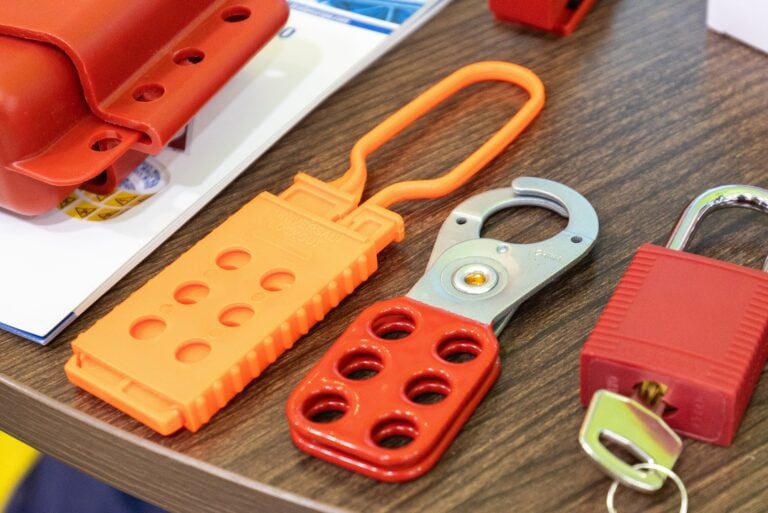
Two numbers decide whether a hasp will work on a big isolation point: the jaw diameter and the number of lock holes. Jaw diameter is the one people get wrong.
Most lockout hasps open to 28mm. That covers most valve levers and switch handles on site. But a large gate valve handwheel spoke, a heavy-duty isolator lever or a thick switchgear handle can easily sit above that, and a hasp that won’t close is a hasp that isn’t isolating anything.
This hasp size guide covers how to measure the point before you order, what the jaw sizes run to, and what to do when the lever is bigger than any hasp in the range.
Why Hasp Sizing Gets Overlooked
Hasps get bought by the box. Someone orders fifty of whatever the site has always used, they go into the lockout station, and nobody checks them against a specific point until a fitter is standing at the valve with one in his hand. That works fine until the plant changes, and a new pump skid arrives with heavier valves.
The other reason is that jaw diameter isn’t obvious from a photo. Two hasps can look near identical online and open to 28mm and 36mm respectively.
There’s also a false assumption that a bigger hasp means a wider jaw. It doesn’t. The LS10038 is the longest hasp in the Locksafe range at 338mm with 36 lock holes, and its jaw still only opens to 28mm. All that extra length is crew capacity, not clearance.
Measuring Jaw Diameter and Shackle Clearance
You need three measurements, and a tape measure won’t do all of them properly. Use vernier callipers if you’ve got them.
Jaw diameter is the widest part of whatever the hasp has to close around. On a valve, that’s usually the lever shaft or the spoke of the handwheel, measured at the point where the hasp will actually sit. On switchgear it’s the handle boss or the padlock loop. Measure the thickest point, not the average.
Shackle clearance is how much room a padlock shackle has once the hasp is closed. This is the one that catches people out. A hasp can close fine and still leave you unable to get a 7mm shackle through the hole because the hasp body is pressed hard against a housing or a cable tray.
Hole size matters if your site standard padlock has a thicker shackle. Locksafe holes run 8mm, 9mm, 10mm and 11.5mm depending on the model, and a 9mm shackle won’t go through an 8mm hole.
Write all three down for each awkward point. It takes about a minute and it means you order once.
Common Oversized Isolation Points in Mining and Industrial Plant
The points that give trouble tend to be the same across sites.
Large ball and gate valves on slurry, water and dewatering lines are the usual culprits. The bigger the line, the heavier the lever, and levers on DN150 and above often push past 28mm at the shaft.
High current switchgear is the other one. Isolator handles on larger switchboards are built for torque, which means a thicker handle and a bigger boss.
Then there’s the awkward middle ground: butterfly valves with a gear operator, conveyor pull-wire latches, and anything retrofitted with an aftermarket lever. These rarely match the original spec sheet, which is why measuring beats looking things up.
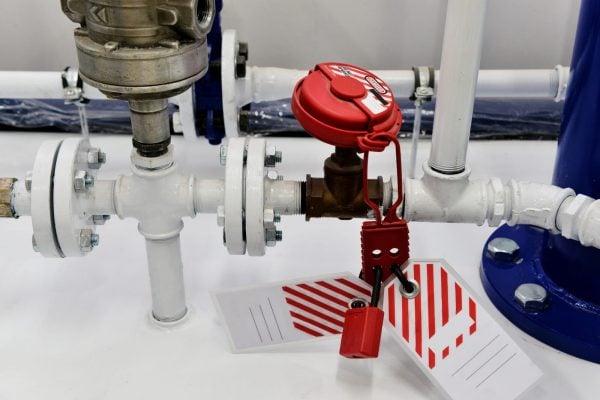
Under the Safe Work Australia Code of Practice for managing the risks of plant, plant has to be isolated and secured before maintenance work starts. A point you physically can’t lock isn’t isolated, no matter how many tags are hanging off it.
Matching Hasp Size to Valve and Switchgear Types
Once you’ve got the measurements, the choice comes down to two questions.
How wide is the point? Anything up to 28mm has the widest selection and the lowest cost. Between 28mm and 32mm you’re into the tamper proof models. Above that, 36mm is the ceiling in the standard range.
How many people need to lock on? That’s separate from fit, and it’s where the long hasps earn their keep. A two-person job doesn’t need 36 holes. A shutdown with four trades and a supervisor does, and running out mid-shift means daisy chaining a second hasp, which adds a failure point.
Physical space is the part a hasp size guide can’t answer for you. The LS10002 has a 28mm jaw with deliberately smaller jaws for restricted access, 113mm overall at $27 plus GST. On a valve bank where levers sit 100mm apart, a 328mm hasp won’t fit even if the jaw does.
For switchgear where the hasp stays in place between jobs, the tamper proof models with a 5.3mm solid stainless shackle (LS10008, 32mm jaw, $35 plus GST) are the better pick. A scissor hasp on an exposed board invites someone to knock it off.
Hasp Size Guide: Locksafe Jaw Diameters at a Glance
| Model | Jaw diameter | Lock holes | Overall size | Best for |
| LS10002 | 28mm | 6 x 10mm | 113 x 40mm | Restricted access, tight valve banks |
| LS10064 | 28mm | 12 x 8mm | 173 x 40mm | General workshop and crew use |
| LS10035 | 28mm | 24 x 8mm | 248 x 40mm | Larger crews, standard levers |
| LS10038 | 28mm | 36 x 8mm | 338 x 40mm | Biggest crew capacity in the range |
| LS10049 | 31mm | 8 x 9mm | 190 x 65mm | Thicker levers, key recess |
| LS10008 | 32mm | 6 x 8mm | 110 x 56mm | Switchgear, tamper proof shackle |
| LS10057 | 36mm | 8 x 9mm | 131 x 66mm | Oversized levers, small crews |
| LS10063 | 36mm | 30 x 8mm | 328 x 66mm | Oversized levers, big crews |
| LS10080 | 32mm plus 600mm chain | 7 x 8mm | 110 x 60mm | Points no jaw will reach |
Prices run from $27 to $81 plus GST across the scissor range, and $28 to $45 for tamper proof.
When 36mm Isn’t Enough
Some isolation points simply won’t take a hasp. A large handwheel with no spoke gap, a valve with a guard around the lever, or a switchgear handle mounted flush to the panel.
That’s what the chain models are for. The LS10080 and LS10072CH pair a 32mm jaw with a 600mm stainless chain at 2mm links, so you loop the chain around the assembly and close the hasp on the chain instead of the handle. $38 to $39 plus GST.
It’s not a workaround, it’s the intended solution for oversized points, and it’s faster than hunting for a hasp that fits geometry it was never designed for.
If you’ve got a point that defeats both, Locksafe manufactures custom gear out of Canning Vale in Perth. Send a photo with the measurements on it rather than assuming the point can’t be locked.
Getting It Right the First Time
Walk the plant with callipers before you order. Note jaw diameter, shackle clearance and hole size at every point you know is awkward, then group them.
Most sites find they need two or three hasp models, not twelve. A standard 28mm for the bulk of points, one wider 36mm option for the heavy valves, and a chain model for the handful that won’t take either.
Browse the full hasps range for specs on every model, and if you’re building or reviewing your isolation procedure, the guide to maintenance and repair safety of plant equipment using hasps and locks covers where hasps sit in the wider process. It’s also worth checking how many workers can lock a single hasp before you settle on hole count.