The hasp material you choose has as much bearing on how long your lockout program stays reliable as the procedure behind it. A hasp sitting in coastal salt air, mine site dust or direct UV for a couple of years behaves very differently depending on whether it’s stainless steel or nylon, and picking the wrong one means replacing hardware well before it should have worn out.
Here’s how the two materials perform under Australian site conditions, and which one suits which environment.
Why Hasp Material Matters for Site Safety
A lockout hasp only does its job if it stays intact and functional for the life of the isolation. A hasp that’s corroded, cracked or brittle can fail to hold a padlock securely, jam so a worker can’t remove their own lock at the end of a shift, or break outright under load.
Material choice also affects whether a hasp is fit for the environment it’s deployed in. A hasp rated for general indoor use won’t hold up the same way on a coastal jetty, in an underground mine with corrosive groundwater, or on plant exposed to direct sun for ten hours a day. Getting the material right up front is cheaper than replacing hasps every twelve months because the wrong one was specified for the site.
Stainless Steel Hasps, Strengths and Limitations
Stainless steel hasps are the standard choice for sites that need mechanical strength and long-term durability. A 316-grade stainless hasp resists corrosion from salt spray, industrial chemicals and general weathering far better than mild steel or zinc-plated alternatives, which makes it the go-to for marine, coastal and heavy industrial sites.
Strength is the other advantage. Stainless steel handles high loads and repeated impact without deforming, and it holds up in high-traffic environments where hasps get knocked, dropped or leaned on daily. It also performs consistently across temperature extremes, which matters for sites that swing between summer heat and cold mornings.
The trade-offs are weight and conductivity. Stainless hasps are heavier than nylon, which is a minor factor for most fixed isolation points but adds up if a hasp needs to be carried around a site regularly. Being electrically conductive also means stainless isn’t the right choice for isolation points near live electrical equipment, where a non-conductive hasp is the safer option. Cost is higher too, though the extended service life usually offsets this over the hasp’s working life.
Nylon and Composite Hasps, Strengths and Limitations
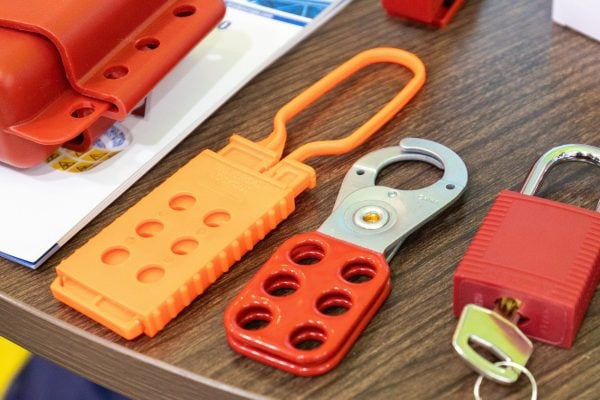
Nylon and composite hasps solve the conductivity problem outright. Because they don’t conduct electricity, they’re the preferred choice around electrical switchboards, control panels and any isolation point where a metal hasp could pose a shock risk if it ever contacted a live component.
They’re also lighter, which matters on jobs where hasps get moved between isolation points or carried by workers doing rounds across a large site. Nylon doesn’t rust, so it avoids the surface corrosion that eventually affects lower-grade metal hasps, and it’s generally more affordable, making it a practical option for sites with a large number of isolation points to cover.
The limitations show up over time rather than immediately. Nylon is more sensitive to prolonged UV exposure than stainless steel; without UV stabilisers built into the material, it can become brittle and crack after a few years in direct sun, which is a real consideration given how much UV exposure outdoor Australian sites get. It also has a lower mechanical strength ceiling than stainless steel, so it’s better suited to isolation points that see moderate handling rather than constant impact or heavy loads.
Corrosion, UV and Chemical Exposure Compared
Corrosion resistance clearly favours stainless steel, particularly 316 marine grade, which is built to withstand salt spray and won’t rust or pit the way lower grades of steel do. Nylon doesn’t corrode at all, since it’s not a metal, but this advantage only matters if the hasp also holds up structurally over the same period, which brings UV back into the picture.
UV exposure is where the comparison shifts. Stainless steel is largely unaffected by sunlight, while nylon needs UV stabilisation to avoid degrading over time outdoors. A UV-stabilised nylon hasp holds up reasonably well for years in the Australian climate, but an unstabilised one can become noticeably brittle within twelve to eighteen months of constant sun exposure.
Chemical exposure depends on what’s on site. Stainless steel handles most industrial chemicals and washdown environments well, though certain acidic or highly corrosive substances can still affect it over time. Nylon resists a different set of chemicals well but can be more vulnerable to specific solvents. If your site uses chemicals regularly, it’s worth checking the manufacturer’s compatibility guidance for both materials rather than assuming either one is universally resistant.
One factor that’s easy to miss is galvanic corrosion. Fitting a stainless-steel hasp directly against dissimilar metals, such as galvanised steel or aluminium fittings, can accelerate corrosion at the contact point rather than prevent it, particularly in damp or salt-laden air. Where a hasp is going to sit against other metal hardware, check the isolation point’s existing materials before assuming stainless is automatically the safer pick.
Which Material Suits Mining, Marine and Coastal Sites
Marine and coastal sites are where 316-grade stainless steel earns its cost. Salt air accelerates corrosion on anything less resistant, and the mechanical strength stainless offers stands up to the heavier plant typically found on ports, jetties and coastal industrial facilities.
Mining sites often need both materials, depending on the isolation point. Stainless suits fixed, high-load isolation points exposed to dust, moisture and rough handling, while nylon is the better choice around electrical switchrooms and control panels where conductivity is the deciding factor rather than raw durability.
General industrial and commercial sites without heavy corrosion or UV exposure can often use nylon hasps throughout, taking advantage of the lower cost and lighter weight without the corrosion risk being a major factor.
It’s worth working out total cost over the hasp’s working life rather than comparing purchase price alone. A cheaper nylon hasp that needs replacing every year or two on a harsh coastal site can end up costing more than a stainless hasp bought once and left in place for a decade. Conversely, buying stainless for a low-risk indoor isolation point that never sees corrosion or heavy load is paying for durability the site doesn’t need. Matching the material to the real conditions, not just the budget line, is what keeps the lockout program both compliant and cost-effective over time.
Whatever the site, it’s worth checking how your existing hasps are holding up before assuming the current material is still the right call. Our guide on the signs it’s time to replace a lockout hasp covers the wear indicators to look for on both stainless and nylon hardware.
Locksafe stocks both stainless steel and nylon hasps across our hasp range, including 316-grade marine options and UV-stabilised nylon for outdoor use. If you’re not sure which material suits your site, get in touch with our team and we’ll help you match the right hasp to the environment it’s going into.