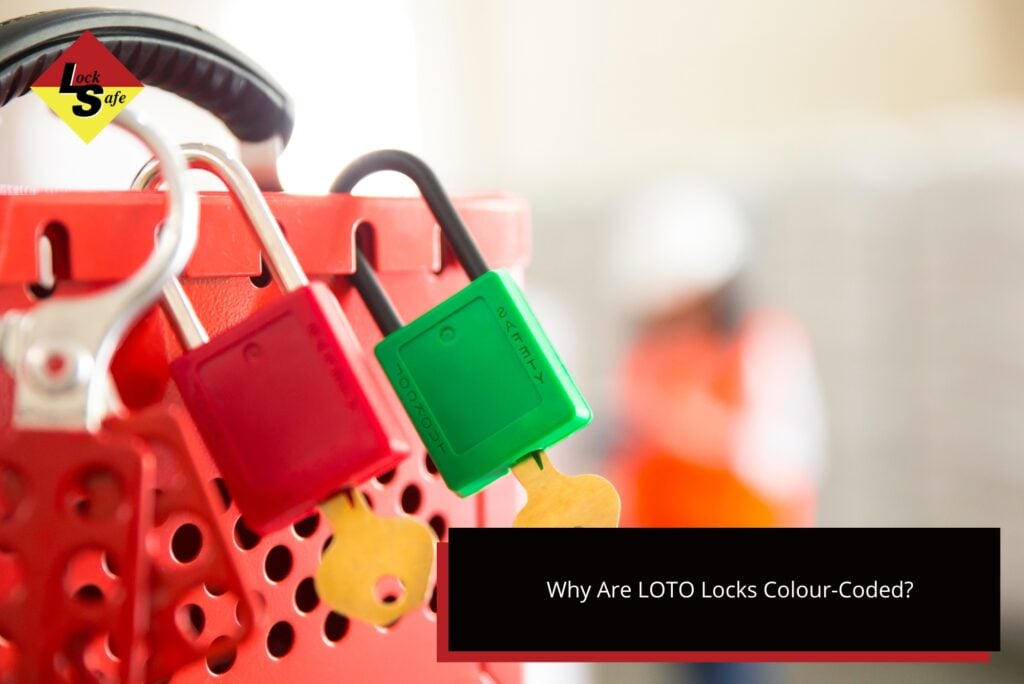
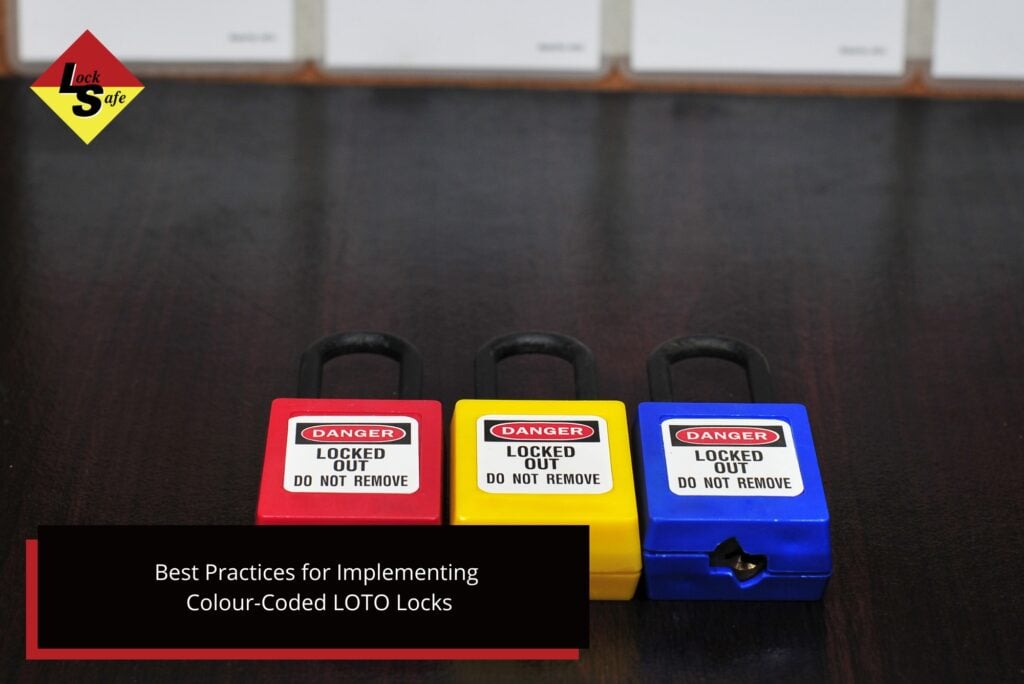
On most Australian sites, red is the personal danger lock applied by the individual worker, yellow marks a group or master isolation, blue is used by contractors, and green usually means equipment is tested and safe. No Australian standard sets these colours by law. Each workplace defines its own scheme in its isolation procedure, so always check your site rules first.
Colour coding matters because it answers three questions at a glance: who applied this lock, why, and who is allowed to remove it. On a site where a dozen trades work on the same plant, that is the difference between a controlled isolation and an incident.
This guide covers the colours used across Australian industry, how group and master isolation locks fit in, what the standards actually require, and how to set up a scheme that works.
Isolation Lock Colour Code Chart
Use this as your starting point. Confirm each colour against your own site isolation procedure before applying it.
| Colour | Common meaning | Who applies it | Who removes it |
|---|---|---|---|
| Red | Personal danger lock, personal isolation | The individual worker | Only that worker |
| Yellow | Group isolation or group lock box | Group isolation officer or permit holder | Officer, once all personal locks are off |
| Blue | Contractor or external worker | Contractor or external maintenance crew | That contractor |
| Green | Equipment tested, safe, or out of service | Supervisor or authorised person | Authorised person |
| Orange | Supervisor or verification lock | Supervisor or safety officer | That supervisor |
| Black | High-voltage or high-risk energy source | Authorised HV personnel only | Authorised personnel only |
| Purple | Site-specific, often specialist trade or hazardous materials | As defined by site procedure | As defined by site procedure |
| White | Rarely used, sometimes trainee or visitor | As defined by site procedure | As defined by site procedure |
Important: there is no legally mandated national colour code in Australia. This chart reflects common industry convention, not a regulatory requirement.
Red Isolation Locks and Personal Danger Locks
Red is the most widely recognised isolation lock colour in Australia, and it carries the most weight. A red lock is a personal danger lock. It says a named person is working on this plant and their safety depends on it staying isolated.
The rule is simple and absolute: one lock, one person, one key. The worker who applies the lock is the only person who removes it. No supervisor, no shift handover, no exceptions outside a formal documented lock removal procedure.
Red locks are normally used with personal danger tags carrying the worker’s name, the date, and a description of the work.
Example: a fitter isolating a conveyor drive applies their red personal danger lock to the isolation point and keeps the key on them for the duration of the job.
Common mistake: keeping spare keys in a supervisor’s drawer. That defeats the entire point of a personal danger lock.
Yellow Locks, Group Isolation and Master Isolation
Yellow is where most confusion sits, because it covers two related but distinct jobs.
Group isolation locks
When more than one person, or more than one trade, works on the same plant, a group lockout applies. The isolation officer isolates every energy source and applies a yellow group isolation lock to each isolation point. The keys to those locks go into a group lock box.
Every worker then applies their own red personal danger lock to the lock box. The box cannot be opened, and the yellow locks cannot be removed, until every personal lock has come off. One box, one point of control, and nobody gets left behind.
Master isolation locks
A master isolation lock is applied by the permit holder or isolation officer over an entire isolation, often on an isolation cabinet or a multi-point scheme rather than a single switch. On many sites the master isolation lock is yellow; on others it is a distinct colour reserved for that role. Master isolation tags are commonly yellow or yellow and black.
How many locks does a group lockout need?
One yellow group isolation lock per isolation point, plus one red personal danger lock per worker on the group lock box. A job with four isolation points and six workers needs four yellow locks and six red locks.
Blue Isolation Locks for Contractors
Blue marks work by someone who is not on the permanent workforce. Contractors, external maintenance crews, and specialist service technicians.
The point is traceability. When a site runs a mixed workforce, blue locks let the permit holder see at a glance which isolations belong to external personnel, which matters for inductions, permits, and end-of-shift reconciliation.
Example: a contracted refrigeration technician applies a blue lock to a chiller isolator, distinguishing their isolation from the in-house maintenance team’s red locks on the same plant.
Contractors should be inducted into the site colour scheme before they start, not handed a lock at the gate.
Green Locks: Safe, Tested, or Out of Service
Green is the least consistent colour across Australian sites, and it is worth being careful here. Two conventions are in common use:
- Tested and safe. Green indicates the isolation has been proven de-energised and verified. Used alongside a test-before-touch step.
- Out of service. Green marks plant that is unavailable but not under active personal isolation, usually paired with an out-of-service tag rather than a danger tag.
Some sites also use green for equipment-specific isolations that need special handling.
Because green carries opposite implications on different sites (safe to approach versus do not operate), it is the colour most worth defining explicitly in your written isolation procedure.
Orange Locks for Supervisors and Verification
Orange is typically assigned to supervisors, safety officers, or permit holders who oversee an isolation rather than perform the work.
An orange lock usually means one of two things: verification is pending before re-energising, or an additional layer of control has been imposed above the working party’s locks.
Example: before a switchboard is returned to service, the site supervisor applies an orange lock and does not remove it until the permit is signed off and the area is confirmed clear.
Black Locks for High-Voltage and High-Risk Energy
Black is reserved for the highest-risk isolations: high-voltage switchgear, hazardous materials, and stored energy sources that could cause serious harm if released.
Black locks are restricted to authorised personnel with the relevant competencies. On most sites, an HV switching operator is the only person permitted to apply or remove one.
Example: an HV operator applies a black lock to an 11kV switchboard isolation point, and the lock cannot be touched by the mechanical trades working downstream.
Purple and White Locks
Purple is genuinely site-specific. Some sites use it for a specialist trade, some for hazardous materials isolations, some for long-term or extended isolations that span multiple shifts. There is no widely shared convention, so purple means whatever your isolation procedure says it means.
White is uncommon. Where it is used, it usually marks trainees, visitors, or supervised personnel who cannot hold an isolation in their own right.
If your site uses either colour, define it in writing. If it does not, do not introduce them without a reason.
Colour Coding by Department or Trade
Role-based colour coding is not the only approach. Many Australian sites colour code by department or trade instead, or run both schemes together. A typical trade-based scheme:
| Trade or department | Lock colour |
|---|---|
| Electrical | Red |
| Mechanical | Blue |
| Instrumentation | Yellow |
| Production and operations | Green |
| Contractors | Orange |
| HV and specialist | Black |
When trade-based coding works well: large sites with clearly separated trade groups, where a supervisor needs to identify which crew owns an isolation without reading every tag.
When role-based coding works better: smaller sites, or sites where the personal-versus-group distinction matters more than which trade applied the lock.
Running both: the common approach is red reserved for personal danger locks regardless of trade, with the remaining colours allocated by department. Lock body colour handles the role; engraving handles the individual.
Whichever scheme you choose, engrave locks with the worker’s name or ID number. Colour tells you the category, engraving tells you the person. Locksafe supplies custom engraved padlocks in every colour above.
Electrical Isolation Lock Colours
Electrical isolations carry specific requirements beyond the general colour scheme.
- Use non-conductive lock bodies. Thermoplastic or nylon-bodied padlocks such as the LS410 Masterlock padlocks are dielectric and suitable for use around live electrical equipment. A brass or steel-bodied lock on an electrical isolation point is a hazard.
- Separate LV and HV. Most sites reserve black for HV isolations and use the standard scheme for low voltage. Mixing them removes the visual warning that tells a mechanical trade to keep clear.
- Test before touch stays mandatory. A lock and a tag prove an isolation has been applied. They do not prove the circuit is dead. Colour coding never substitutes for proving de-energisation.
For the procedure around the lock, see our guide to safe electrical isolation practices.
Positive Isolation and Lock Colours
Positive isolation means the energy source is physically separated, not merely switched off: a rack-out circuit breaker, a removed spool piece, a blind flange, or a locked-open disconnect.
Colour conventions on positive isolation vary. Some sites apply the standard personal and group colours to the positive isolation point in the normal way. Others reserve a distinct colour to flag that the isolation is physical rather than control-based, so nobody assumes a control isolation is sufficient.
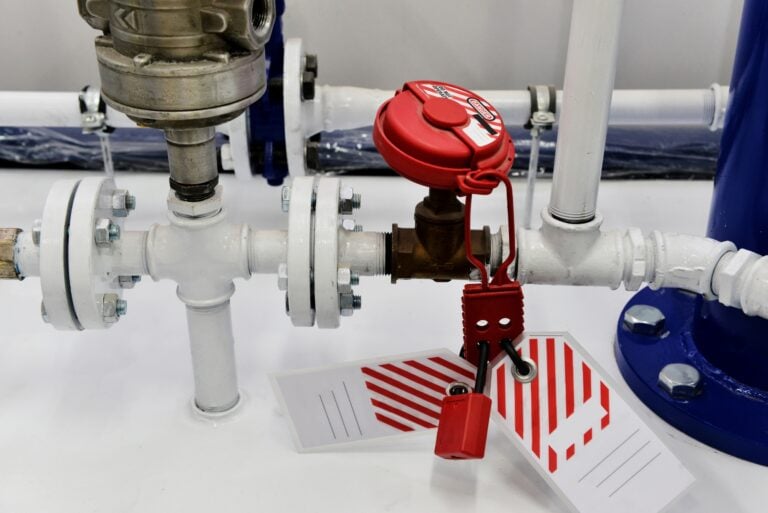
The practical point: a positive isolation point often has no switch to lock, so it needs lockout hasps, locking brackets or a valve lockout device to accept a padlock at all.
Isolation Tag Colours
Locks and tags do different jobs. The lock physically prevents operation. The tag carries the information: who, why, when, and what happens if it is removed.
| Tag type | Typical colour | Meaning |
|---|---|---|
| Personal danger tag | Red and white | A named person is working on this plant. Do not operate |
| Out of service tag | Yellow and black | Plant is faulty or unavailable. Do not operate |
| Group isolation tag | Yellow | A group isolation is in force under a permit |
| Information tag | White or blue | Supplementary information about the isolation |
A danger tag without a lock is a request. A lock without a tag is an unexplained obstruction. Australian practice is to use both. More on danger and out of service tags in our plant equipment safety guide.
What Australian Standards Actually Say About Lock Colours
This is the part most guides get wrong.
No Australian standard mandates specific lock colours. AS/NZS 4836:2023, Safe working on or near low-voltage and extra-low voltage electrical equipment and installations, sets out requirements for isolation, lockout and tagout, but it does not prescribe a national colour code. Neither do the model WHS Regulations 2011, which require control of hazardous energy under Part 3.1 without specifying lock colours.
What is required
- A documented, site-specific isolation procedure that names the isolation points for each item of plant
- Training and competency for everyone applying or removing isolations
- Personal locks and tags under the control of the individual worker
- Verification that the isolation is effective before work begins
What is convention, not law: every colour in this guide.
The practical consequence is that your site’s written procedure is the authority, not an industry chart. If a contractor arrives with a different scheme, the site procedure wins, and the induction has to cover it.
Regulator guidance varies by state. In Western Australia, WorkSafe WA sits under the Department of Energy, Mines, Industry Regulation and Safety. Safe Work Australia publishes the model codes that most states adopt. For the wider system, read our full lockout tagout guide.
Setting Up a Colour Scheme That Works
- Write it down first. A colour scheme that exists only in people’s heads is not a scheme. Put the colour table in the site isolation procedure and in the induction pack.
- Keep red for personal only. Whatever else you do, do not dilute red. It should mean one thing on your site: a named person is working on this plant.
- Engrave every lock. Name or employee number, on the lock body. Colour identifies the category, engraving identifies the person. Without engraving, a red lock on an isolation point at 2am tells you nothing useful.
- Match the lock to the environment. Non-conductive bodies for electrical work. Stainless shackles for corrosive or marine environments. Weather-resistant tags for outdoor isolation points.
- Audit quarterly. Check that colours in use match the documented scheme, that no unauthorised locks have appeared, that engraving is still legible, and that damaged locks have been replaced. Record what you find.
- Induct contractors on your scheme, not theirs. A contractor who uses blue for personal locks on their last site will apply blue here unless told otherwise.
- Control your key management. Keyed differently for personal locks, keyed alike only where a single person or role controls the whole set. Never hold spare keys to personal danger locks.
- Give the locks a home. A well-planned lockout station setup keeps every colour where the crew expects to find it.
Frequently Asked Questions
What colour is a personal isolation lock in Australia?
Red, on most sites. A red lock is a personal danger lock applied by an individual worker and removed only by that worker. No Australian standard mandates this, but it is near-universal industry convention.
What colour is a group isolation lock?
Yellow, on most sites. The group isolation lock is applied by the isolation officer to each isolation point, with the keys secured in a group lock box that each worker then locks with their own red personal lock.
Is there a legal colour code for LOTO locks in Australia?
No. Neither AS/NZS 4836:2023 nor the model WHS Regulations prescribe lock colours. The colours are industry convention and are set by each workplace’s documented isolation procedure.
What does a black lock mean?
Black is normally reserved for high-voltage or high-risk energy isolations and is restricted to authorised personnel with the relevant competency.
What is the difference between a red lock and a blue lock?
Red is a personal danger lock applied by a member of the permanent workforce. Blue usually marks an isolation applied by a contractor or external worker, so the permit holder can distinguish internal from external work.
Can I use the same colour for personal and group locks?
It is not recommended. The distinction between a personal danger lock and a group isolation lock is the core control in a group lockout. Using one colour for both removes the visual signal that tells a worker whether they still need to apply their own lock.
How many locks does a group lockout need?
One group isolation lock per isolation point, plus one personal danger lock per worker on the group lock box.
What colour is an out of service tag?
Usually yellow and black. An out of service tag marks plant that is faulty or unavailable, as distinct from a personal danger tag, which is red and white and means a named person is working on the plant.
Need Help Setting Up Your Isolation Lock Scheme?
Locksafe manufactures and supplies isolation equipment for Australian mining, industrial and construction sites. Masterlock 410 and Lockwood 312 padlocks in eight colours, keyed alike or keyed differently, with custom engraving. Group lock boxes, hasps, locking brackets and isolation cabinets to suit.
If you are setting up a new scheme or reviewing an existing one, get in touch. Call +61 (0)8 9455 7255 or contact our team.